
A Mind of One’s Own?: Reflections by a Third Year BA Student, DU
05 February 2026 | Delhi University
The following is a note received by a student of BA English at DU now in their sixth semester of the NEP four-year-undergraduate programme.
What do I say to the question of what I want to do in my life when I myself am clueless about it, or perhaps made clueless by design? They say that Britishers didn’t want to raise a class apt in thinking but those who obeyed, like animals. To kill one's intellect should be considered a crime but why would they do so when it would be those among themselves whom they would have to hold accountable? They want to maintain their hegemony, the status quo. They should not think for themselves to figure out what they want to do lest the structure would crumble.
Tell me, how do you become a critical thinker? The best answer I can give is by engaging in the habit of thinking, with the literature that makes you think, participating in the process of asking questions and finding answers to them. But do our degree courses help us do so? Not a resounding yes, I would say. It's diabolical. For I feel that I did not get enough time to think. To stay with one text, grow with it by re-reading it, re-interpreting it. My process: read the text, attend the lectures, read the critical essays pertaining to that text, and done. Because exams come over breaking the door of my attic asking me to regurgitate. Three hours is the duration, and you have to write critically for every question asked in the exam (there are a total of six). And how do you do that? By spilling out what you just read. Not your own thoughts but those you come across while reading the critical essays. Scholars we are meant to be, and incompetent we actually become despite our own best efforts and those of a few professors who actually want to teach and engage with the class, not fatten up their bellies eating samosas on their salaries.
In my undergraduate programme, there are seven papers taught every year till the beginning of the semester five (third year): three core papers, one General Elective, Discipline Specific Elective (introduced in third semester which we can take in place of GE if we want but is mandatory from the fifth semester onwards), Ability Enhancement Course (in which we are taught Environmental Studies (EVS) in semester one and three, and a language paper such as Hindi in semester two and four, at a very elementary level), Skill Enhancement Course, and Value Added Course. Value there is so much that we find it impossible to digest, which is probably why we have to “vomit” it out in the exams; smart thinking I must say and I have not even started talking of the fourth year which I do not plan to do anyway. Every paper is allotted roughly forty-five hours over a period of fifteen weeks (about 3.5 months) and VAC and AEC are not taught from the semester five onwards. The core papers, GE and DSE are given primary importance as they weigh more than the other four in terms of marks; their end-semester examinations are of ninety marks each, and that of the AEC is of fifty with practical for EVS and sixty for language; that of SEC is either of thirty with practical or only practical with no theory exam at all; for VAC, it is of thirty. Though the twist is that other than the core, GE and DSE papers, nothing else matters as no one, even the professors, saving a few, take them seriously. Some professors come to teach but they describe the things just for their own sake, disinterested in teaching or even if the others are interested and make efforts, the outcome remains the same: “information regurgitation”. We are asked to write it all out as fast as we can under a certain time limit and showcase our “talent” of memorising facts and figures. No new skill is learned, no new value is added, no development takes place. Thus, perhaps, the apathy of some of the professors.
And this predicament is “enriched” by the internal assessment which, by the way, takes place of all the seven papers at almost the same time: assignments, class tests, presentations; they “elevate” our lives so much that we get time to do nothing else. A hobby? What is that? Who wants to read books beyond their syllabus anyway? Nietzsche, Poe, Woolf, Dostoevsky, Orwell; not good. And what’s a guitar? What does music have to do with literature? “Students should only restrict themselves to their prescribed readings because they are the definite ones. They are the canons. Nothing matters beyond that, for we have designed the syllabus.”
For instance, in a VAC Paper called ‘The Art of Being Happy, we are taught about happiness but never really experience it, for we know that it is only extra weight we have to bear to score in exams. The syllabus is as follows:
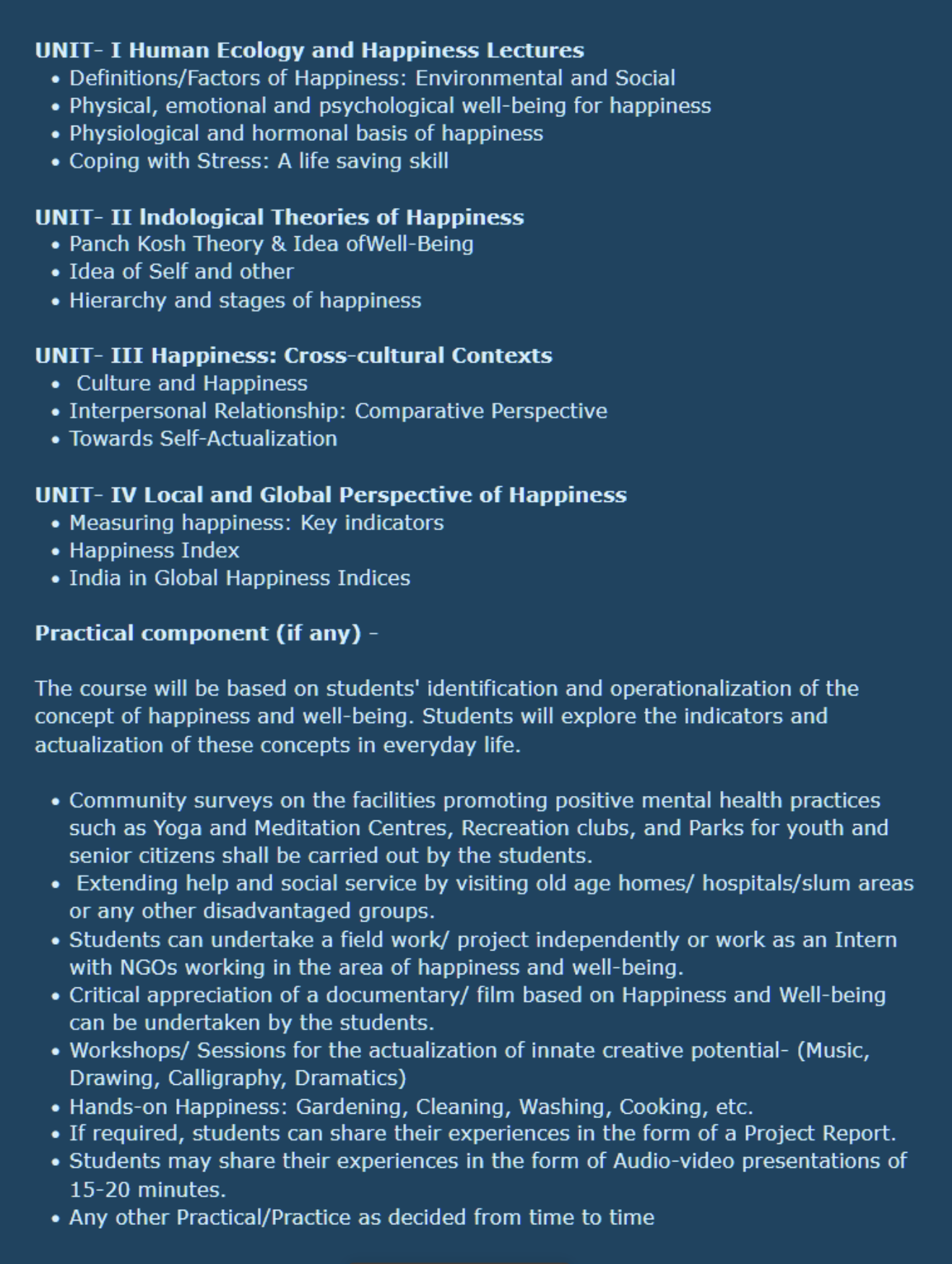
Words on the page, so beautiful yet disconnected from reality. NEP: Non-Education Policy. For the paper was not a therapy but trauma: theory was taught with not much significance. The enlightenment that should have followed was nowhere to be seen, maybe because the professors themselves were not happy, willing to get done with this paper with minimal friction. Nothing so grand happened in the name of practical but a class test and assignments were sure to follow; the Happiness was converted into credits, and the Art was lost amidst the storm of internal evaluation. Thus, we rank so low on the Happiness Index.
To talk of Hindi (AEC), well, the situation is diabolical: we are taught “स्ववृत लेखन” (Resume/CV), “कायार्लयी और व्यवसाइक पत्र लेखन” (Office and business letter writing), “प्रिंट माध्यम के लिए लेखन (साक्षात्कार, यात्रा अनुभव लेखन)” - Writing for print media (interviews, travel writing), “विज्ञापन लेखन” (Advertisement Writing) and the like. I am about to enroll in a postgraduate programme and still have not been able to comprehend which ability of mine was enhanced. This predicament cannot be stressed enough that AEC, VAC and SEC papers are designed in such a way to provide no cultivation of intellect at all as the goal is to repeat what is taught in the examinations.
There have been a few professors who are actually concerned with teaching. Spending a week or so on the historical, cultural, social, economic and political backdrop of the prescribed texts of a particular century. They have taught about what the Victorians cared about; the inwardness of the Romantics; the trauma of the African-Americans; the plight of the Dalits; the misery of the women; the isolation of the Modernists - “The horror! The horror!” Moreover, they have even suggested the books beyond the syllabus. They are the ones who have played a primary role in the cultivation of what little intellect I have got. They make sure to actually engage with a text, giving it the time it really needs; with students, giving the time to their questions they really need. They foster the interest of students in the texts they teach. Beloved is a novel one cannot just put aside after reading it.“It was not a story to pass on”. One may want to stay with it for a few weeks, perhaps even a month, going through what the scholars have written about it, trying to absorb the novel, bit by bit. But, as you know, lovers cannot meet. There are other texts to be taught, their scholarly material to be read, so that one does not appear in the exam unprepared, without cramming the ideas.
This is to say that despite the best of the efforts of both the professors and students, the framework is restrictive, confining by its very nature. Literature is meant for liberation but the programme's structure stands in contrast to that idea. Why can’t we be like Finland? Why can’t we be happy? The predicament is such that one of my friends is repulsed by the idea of writing a research paper, notwithstanding the fact that they are brilliant in studies, in the top ten of my class. Even I am not confident in this endeavour, thinking of myself as incapable of writing one. Is this what this course meant to foster in us: the fear of writing a research paper? I believe there is a lack resulting in such a repulsion, apprehension. I think as much as the focus is on the original thought, there is not much on the original word. While there is a paper called Research Methodology dedicated for this purpose, it is only in the sixth semester (third year). I suggest a balanced focus on both thought and word throughout the three years. For there is a reason why even after writing assignments and answers in class tests, there is still a lack of confidence in writing a paper. And it is not what you may think it to be, I and that friend of mine, do not cheat. We also want to write, contribute to the production of original thought, in effect, to the whole corpus of literature and not just read the interpretations of others. We also want to be like Urvashi Butalia, Aakash Singh Rathore, Sunaina Arya, Ashis Nandy, Gayatri Spivak. Teach us to write too, not under pressure lest we hate it. There have been some who have but they too are confined in these rigid frameworks. The spirit is not free.
And then there is more to this devilry. After going through such an experience for three (or four) years, if one still wishes to pursue their studies, they have to give an entrance test: CUET PG. I cannot stress enough how diabolical this examination is. Tell me, would you test a painter on how well they can play a flute? This is CUET PG in a nutshell, testing students on the basis of those exact things the foundations of their field stand in stark contrast to. Students are asked multiple choice objective questions forcing them to memorise certain facts such as the chronology of Shakespeare’s plays, the date of publication of texts, of wars fought and the parties involved, and the like. Four options are given and one is rewarded with four marks for the right answer and one mark is deducted for being wrong. A total of seventy-five questions are asked and the time duration is one hour and thirty minutes. For instance, they would ask whose lives the miracle plays were based on, who among the given options is not a University Wit, and a question as nonsensical as to name the dog of Belinda in The Rape of The Lock. This only proves the objective of this examination is to select only those students who can memorise things well and blurt out the right date, quote the right words and list the right works of an author.
Whereas, Literature is subjective at its very core. Instead of testing the critical skills, they want us to cram those facts and figures god knows for what reason. Why not ask us to submit an essay on questions like: “Why does Godot not come?”; “What is the basis of Dalit consciousness?”; “Why should one write at all?” But as I have written earlier, they don’t want thinking minds, for they want to maintain the status quo. They are scared of rebellion. They are scared of questions. One should not think critically lest they would protest. And the whole of academia is as much an accomplice in this project as those in power if not less. For if they were to care about us, they would not have let such examinations as CUET to exist in the first place.
Thus, this country is doomed. Thus, the brain drain. We are not fostering free thinkers - the organic intellectuals, as Antonio Gramsci calls them, but the traditional ones who strive towards maintaining the status quo, keen on maintaining a hierarchical order in society; an ever widening class, caste and gender divide assigning places for the wealthy, savarna man way above on the vertical plane than the poor, Dalit woman. Thus, we need Ambedkar, Jyotirao Phule, Periyar, who know how it feels like to be crushed, trodden upon.
“Until they become conscious they will never rebel, and until after they have rebelled they cannot become conscious.”
― George Orwell, 1984
If our education system contained much substance there would not be taking place countless, brutal rapes across our country not uncommonly; there would not be so many people below the poverty line sleeping on roads unlikely to have a proper healthy meal thrice a day; there would not be happening killings of Hariom Valmikis and Bimlas. And because we are made to be ignorant of the past of the Partition by just delineating the dates and events, that the Hindus and the Muslims thirst for each other’s blood. That if the effort was put into studying the silence behind those cold dates - as Urvashi Butalia did - perhaps we would have realised the pain was of both the sides: women were abducted, raped and converted regardless of their religion; children were killed or made orphans regardless of their religion; homes were left barren regardless of their religion; that tears were shed regardless of their religion. (the whisper in my head says to me while writing this, “Big Brother is watching you”).
The fact is, we need radical reform. It has been decades since we have been subject to a framework designed to curtail our intellectual and creative pursuits. And despite this predicament, we have had rebels: the teachers, professors, and content creators, fighting everyday against this very condition to bring a change; to cultivate our minds and realise in us the potential to be rational. Their war is against cramming and regurgitation; their war is for free thinking and a critical mindset which is ever willing to unlearn those beliefs and outlooks proven redundant at the face of Truth; to help us reclaim our minds and really call it our own.