
The Many Faces of Academic Freedom
Dunu Roy | April 2026
Dunu Roy | April 2026
I may be wrong, but isn’t the role of academia to advance society through the creation, preservation, and dissemination of knowledge? Thus, within the ambit of academic freedom, do we seek to protect independent analysis and debate, only through research and teaching, or also through public service? It is this third element which I hope to highlight before you today.
Being in and out of Bombay and Shahdol district of Madhya Pradesh, for about three decades, exposed me to many upheavals (in urban transport & textiles, railways & mining, education & corruption, plantations & agriculture) as also the varied state response of suppression, or sometimes, accommodation.
Seeking a way to understand these events (like others of my generation) led me, through several pathways, to the town of Wigan in northern England, midway between Manchester and Liverpool, and a major mill town within a large coal mining district during the Industrial Revolution.
Close to Wigan is the city of Salford where Friedrich Engels came to manage his father’s textile mills. In 1884, Engels wrote The Condition of the Working Class in England. He described how workers were forced to earn less, live in deplorable conditions, and die earlier. He also convinced Karl Marx that “A knowledge of proletarian conditions is absolutely necessary to be able to provide solid ground for socialist theories”. This was my first encounter with a face of academic freedom.
Fifty years later, in 1937, the novelist George Orwell (son of a civil servant) wrote his fifth book, The Road to Wigan Pier. His description of the bleak working and living conditions in the Wigan region was vivid and extraordinarily impactful. He also confessed why, in spite of his antipathy towards “fruit-juice drinker, nudist, sandal-wearer, sex-maniac, Quaker, ‘Nature Cure’ quack, pacifist, and feminist”, he was in favour of socialism. That would be a second face of freedom.
Another forty years on, in 1984, Beatrix Campbell (journalist, author, working-class activist), retraced Orwell’s route, and wrote Wigan Pier Revisited: Poverty and Politics in the 1980s. As she documented the voices of women as workers and wives, they questioned her right back with, “What’s your book about then? What’s in it for us?” She concluded with a passionate plea for a “genuine socialism, informed by feminism and responding to people's real needs”; yet another face.
More recently, the Wigan Local History and Heritage Society has emerged as an archive of working people’s tools, processes and memories. One of the ditties in the archive goes: “Its Poverty poverty knocks, me loom is saying all day; poverty poverty knocks, the gaffer’s too skinny to pay.” Another begins with, “Now our stockings are all full of holes, and our clogs they are losing their soles”. Both expose a much darker face of freedom’s epiphany.
These pathways also depict levels of freedom. Engels’ work is cited in well over 20,000 research publications; Orwell is cited in the hundreds; Campbell’s is in the scores; while the Heritage Society’s work is barely known outside Wigan.
Perhaps another pathway could thread these four together. In 1977, severe cutbacks in public spending forced Lucas Aerospace at Burnley, very near Wigan, to reduce production and retrench workers. Members of the British Society for Social Responsibility in Science assisted the workers to respond with an alternative proposal - to retool certain sections of the factory and to produce items of ‘social use’, such as heat pumps and gas turbines for hybrid vehicles.
In the brief time remaining to me let me present three quick stories to illustrate how these faces of freedom have emerged in my, and my colleagues’, work in India.
In 2019, we were discussing the Delhi Master Plan with a group of workers in a Delhi University classroom. One of them asked, “Do you know this classroom was built by us? Why doesn’t the history of Delhi include us as builders?” Another began singing Gorakh Pande’s “बड़े बड़े लोगन के बंगला दो बंगला, अउर भइया झूमर अलग से. कहब त लग जाई धक् से”. That led to a flurry of meetings with historians; and two students were assigned to interview workers. A year later, two dissertations were completed, but the worker’s question about history has remained hanging in the air.
When the Bhilai Steel Plant expanded in the 1980s, it was decided to mechanise the Dalli iron ore mines to meet demand. Instead, the Chhattisgarh Mines Shramik Sangh proposed semi-mechanisation and invited me to prepare an economic analysis. I involved three bright JNU students, who worked hard but could not come up with a viable proposition. My minor contribution was to suggest that they include environmental costs. Their final report was extensively used by CMSS for negotiation. Sadly, protocol attributed the report to me as I had helped to get the grant from ICSSR.
In 1990 two young men accosted us. How could their villages in the Auranga valley be submerged by a proposed dam, when the lower ones were not? We travelled to Barkadih; and trained 19 young people how to measure heights, flows and siltation. As we packed for departure, the youngsters were outraged, “You taught us how to fight a war, but take away the weapon!” They gave us money collected overnight, saying, “Here, go buy yourself a set of measuring tools and leave these!” They then measured water, land and silt; made us analyse and prepare reports in Hindi and English; and used their new skills to stop the dam, as well as construct a hundred local water storage projects.
To conclude, I offer three questions that trouble me about academic freedom, especially in today’s globalised, but individualistic, context:
1. Can public service be performed as part of free academic function?
2. What is the role of the public in contributing to research and teaching?
3. How does the unfree public claim entitlement to academic knowledge?
Freedom, to me, has many faces. Which one is of the essence is something we all perhaps need to collectively think about.
[1000 words]
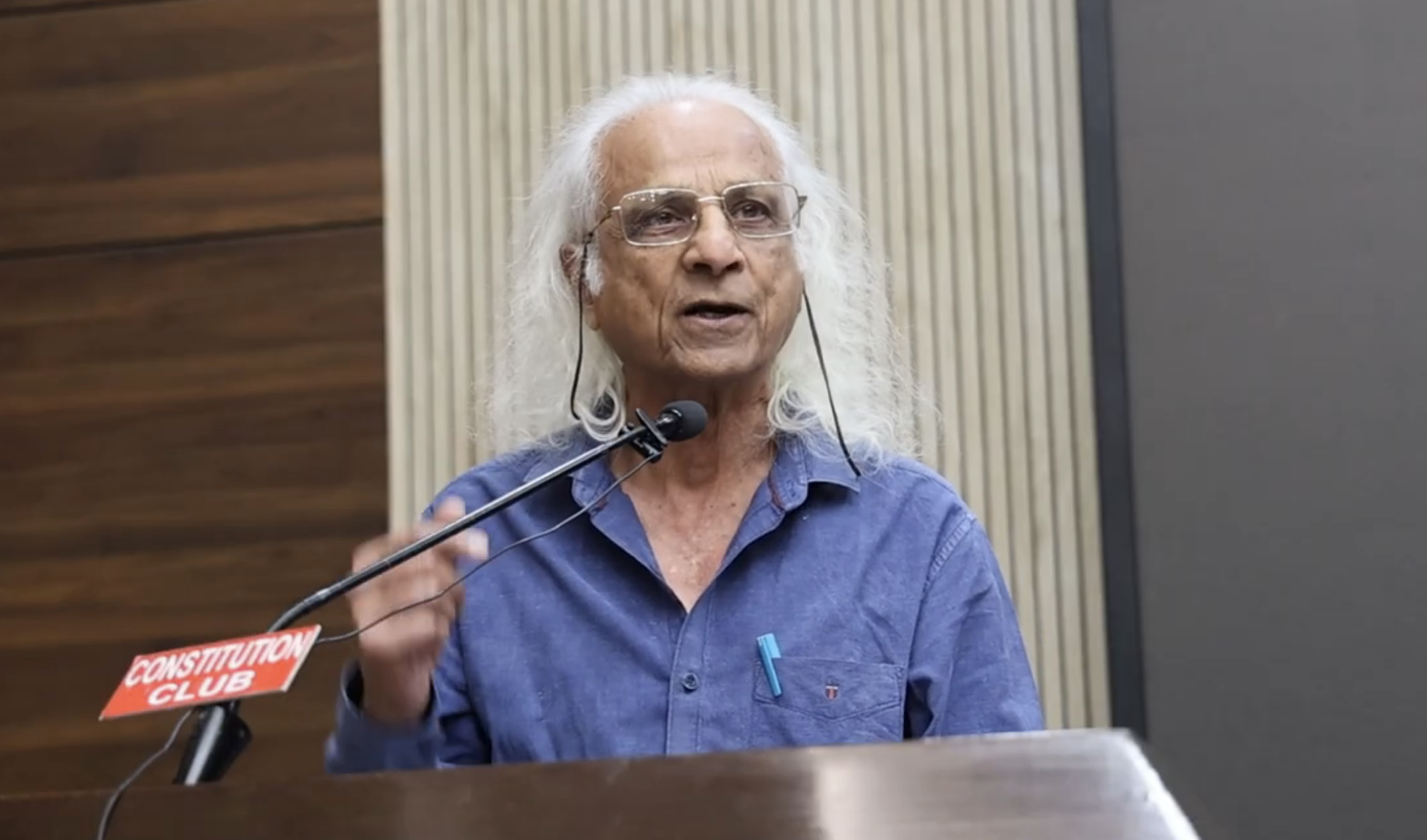
Presented at The State of Academic Freedom in India, Dy Speaker’s Hall, Constitution Club, New Delhi, April 11, 2026. Organised by the India Academic Freedom Network.
Notes from a journal I do not keep
Naveen Kishore
Censoring our ‘specific selves’ in the world we inhabit as publishers
Naveen Kishore, Seagull Books
In a post two thousand and fourteen world the threat of censorship walks willingly with its shadow-self: the self-censoring one.
There is no one truth about censorship. Yes, the State censors. As does the University. The ‘academia’. It does so either by ‘persuasion’ or diktat. Or tangential pressure. As in you have a lecture in Delhi at a public institution who has willingly allowed you the space and then they get a letter from the police ‘gently’ suggesting that you reconsider the event because it is highly possible it may cause some ‘disruption’ to what is called ‘law and order’. Censorship.
‘Top-down dictum’. What does this imply? We know our universities, particularly the private ones do indulge in this form of implied censorship. It is often presented as a ‘virtue’. Or that old argument about letting go of the ‘skirmishes’ in pursuit of the larger victories. To put it bluntly write as instructed or else. We the writers get used to it over time. Survival?
My practice as publisher believes in the ‘voices from below’. I use the word to suggest the ‘underdogism’ of our increasing tribe of have-nots. To turn. The worm. From below. From beneath its acknowledged eye level. Like boring a hole into the floor. From the ceiling below. And catching It unawares. Build the structures you need. Before dismantling them. Like bridges deliberately burnt. Seal the escape routes. Get rid of the steps you had hurriedly strung between two upright lengths of wood metal rope for your ladders. The ones you needed to get to that ceiling. The one you would soon drill to the floor above. Rehearse the revolution. Practice it. You are at risk. Subterfuge. Sleight of hand. Strategy that conceals. Like successful camouflage. The left hand. From the right.
Subversion. Has to begin at the bottom.
To do this publishers like us need to consider a stage before content. I offer you intention. Or intent. Always the intent. Not in a screaming from the rooftop kind of manner. No. Just a quiet awareness about your intent to publish what needs to be published in your opinion and the opinion of your immediate colleagues.
Push further. What if you disentangle the intent from the circumstance. As in your intention to publish that for any number of reasons appears immediate, even vital to ‘put out there’ in the form of a book. The ‘circumstance’ is the political reality of our times and this leads to most of us entering into a relationship with ‘self-censorship’ as a means to survive. A perceived survival because all this while no one has actually stopped you/us from publishing that book you have pre-empted as a ‘victim’ already.
Again, through our personal lens (at Seagull) we have not faced a situation where our authors have had to hesitate and to be watchful. Not yet anyway. One more thought: we do not have an indemnity clause in our contracts. The idea is to stand by them should the obvious unfold.
Here is the dangerous part. We need to be prepared to pay the price for our sticking to intent. Each time you go out on a limb without fear you must be prepared for a pushback. At Seagull we keep our antenna out but do not stop the ‘doing’. Till we are physically stopped. Make no mistake. It is a strong possibility that this may happen. But till it does one must remain in a mode of freedom to publish however imagined this may be. Romantic? Yes. And gratefully so.
I don’t think Seagull’s catalogue would have looked any different were we based in Delhi. There are too many publishers of intent I strongly admire in Delhi. Watchful but continuing to publish. That. Which. Needs. To be published.
Period.
—the state as a chronicler is failing us because they’re not going to objectively record anything but their own histories in the way they wish to, which is distinct from their doctoring history as we notice, right? And then supposedly trying to make it palatable to us, which is very difficult. There is a palpable uncertainty about what is being manifested today. The recording of history has no moorings to rely on. This unfolding—a term I use to describe this time of perpetual war—is without anchor or precedence. And definitely without the underpinning of any morals. Or ethics. Therefore, the first victim is ‘truth’. We can no longer decipher the fake from the actual. Our ‘reality’ unfolds as ‘napalm’. The fire spreads destroying ‘history’ (and entire helpless populations) while it usurps the nomenclature of the ‘historical’ thereby installing the untruth the false the fake the fabricated as that which took place. An erasure as history. The act of erasing becomes our new historical fact.
—a publisher’s role today has changed there’s not enough responsibility to put the kind of books out there that also help create a certain climate for the intellect to thrive, to debate, to observe, to imbibe, to kind of find their own solutions.
—Instead, we pre-empt what we feel will be allowed and therefore dis allow ed by an all-powerful state with a capital S that has created such an atmosphere of fear and anxiety that our publishing priorities have instinctively edited out ‘that which MAY cause offense’ to our iron fisted masters.
—I am on record saying that we can no longer take a stand of neutrality. Everyone needs to take a stand. Talking from a viewpoint from deep within a world community of publishing I do despair at the hollowness of what we are producing. Those of us who attempt to be different are rubbished as ‘romantics’, ‘elitist’, therefore ‘not inclusive’ and so on. I often get accused of yet another ‘privilege’: that of publishing in the English language. As in how easy it must be for me to play first world publisher with a third world currency because my language allows me access. No one treats ‘romance’ with what you set out to do as a virtue. Your lack of algorithm is seen as the privilege of the foolhardy or at best I get comments like ‘oh you are an owner publisher so you can do what the hell you like!”
I think the only truly useful privilege I practice is to keep doing. Regardless.
—Here is another kind of ‘censoring’ we practice:
—One in which the ‘marketplace of books’ takes on the role of an all-encompassing presence that ‘rules’ our senses; our sensibility; our enterprise. Leading to a self-imposed ‘blindness’ in a willing colluding participatory manner.
There’s a sense that, today, we’re publishing in a kind of void. You’ve decided that this is what is palatable, or this is what is going to sell, or this is what is popular. But sometimes you’re not even abdicating this responsibility consciously as a publisher. It’s almost as if you’re oblivious that you have a responsibility.
The book has become a commodity. A spectacle. It’s put out there as a grand, spectacular enterprise, and the content that should sustain the book is missing.
The censoring self goes unnoticed beneath this ‘noise’ and dare I add ‘glitter’.
In this new reality when a publisher receives a manuscript, the first thought is, will it sell? How much will I make on it? Whereas, in fact, one ideally wants the publisher to say, what are the thoughts that are being projected here? Are these the thoughts that I want to support? Or is this a debate that I wish to encourage and set afloat in society? Now, I may be speaking completely incorrectly, but I think there’s a difference between independent publishers and publishers that are hooked onto existing systems of publishing.
If you’re hooked onto a system that is money-making, you’re very lucky if you can do that together with the occasional little book that you sneak in which is thought-provoking. But the independent publishers are people with much more direction in terms of thinking about what they’re publishing.
You and I can count our proud making independents. There is an agenda. There is an intellectual agenda they focus upon because I think that they are trying to produce books that are thought-provoking. And they continue to publish what they feel needs to be published. Regardless of the ever-interfering presence of the ‘S’tate and its Other, the ‘M’arketplace.