
The State of
Academic Freedom
In India
11 April 2026
The State of Academic Freedom in India: Report
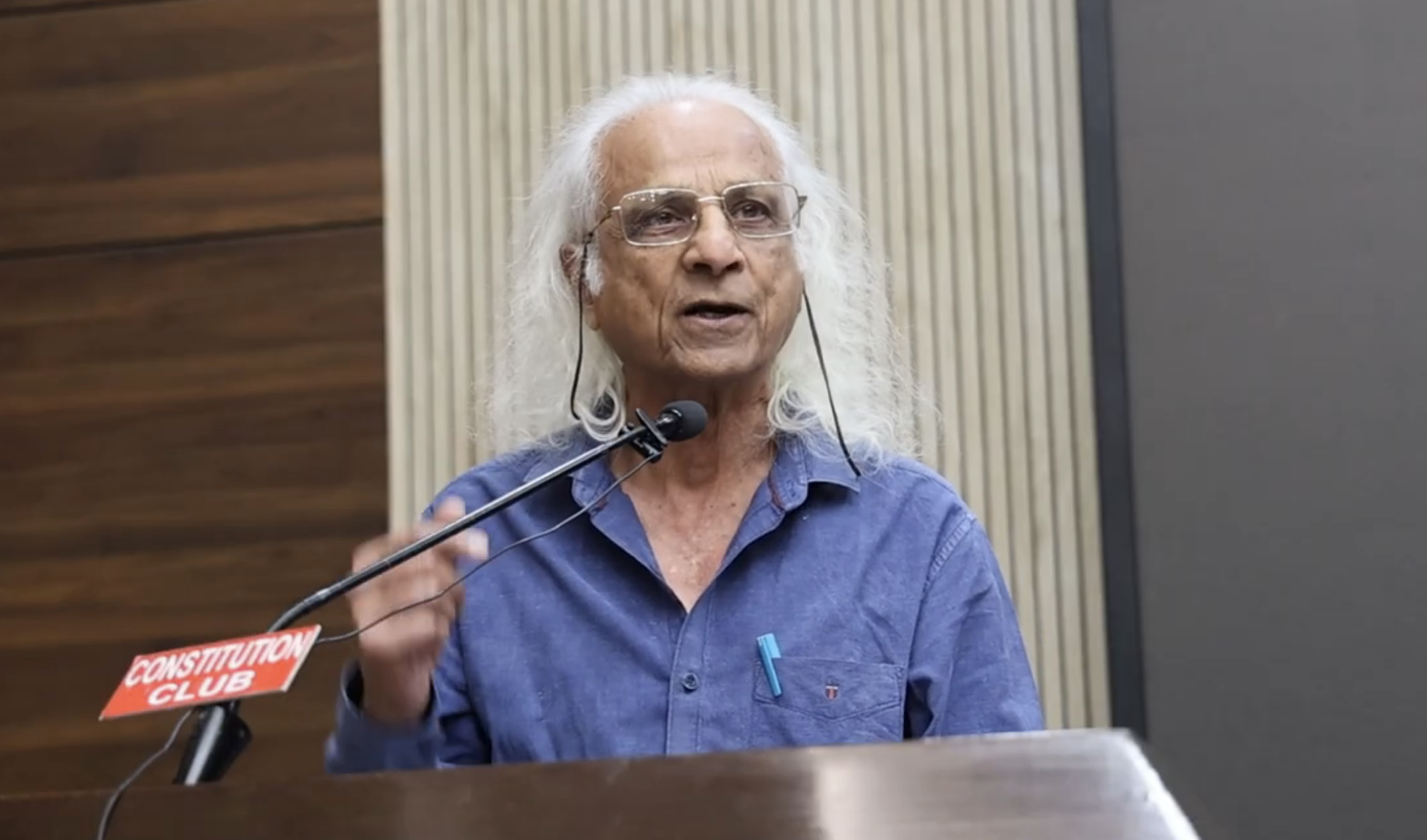
Here is a brief report on the IAFN event held on 11th April at the Constitution Club from 10am to 1pm. We are attaching this along with links to some of the recordings. Not all the sessions were recorded.
In the first session,
Apoorvanand laid out the context in which IAFN was set up three years ago, and its objectives.
Nandita Narain spoke on academic freedom and federalism; how state universities represent the cultural aspirations of the people of the states; and how the UGC (Union Grants Commission) — which was initially set up to maintain standards — began imposing its own control instead. Although education is on the Concurrent List, the post-2014 introduction of NEET (National Eligibility-cum-Entrance Test) and CUET (Common University Entrance Test) run by the NTA (National Testing Agency) takes away from the states’ powers. The 2025 UGC regulation on selection of VCs further reduces the powers of state governments. Funding has been taken out of the purview of UGC and given to the Ministry of Education under the Union Government, and now people can be terminated for opposing the HECI (Higher Education Commission of India) that seeks to replace UGC and other higher education regulatory bodies.
In the second session on the criminalisation and harassment of students and faculty, '
Sameena Dalwai spoke of the structural differences between private and public universities, and the need for individuals to be resilient with love and humour in the face of repression.
An IAFN representative provided an overview of the IAFN tables, highlighting different types of repression. While it keeps a record of the events cancelled/attacked on campus, the events — for instance, the IKS (Indian Knowledge System)-related events on campus — aimed at saffronisation of campuses and curricula are not itemised in the tables.
Aditi Mishra, JNU (Jawaharlal Nehru University) Students’ Union President, spoke of shrinking spaces for students and the number of FIRs on student leaders, who are simultaneously described as fringe elements and highlighted by the administration and media as dangerous. She also pointed out that JNU represents a model of good public education which is cheap and accessible, which goes against the grain of those who want to push the agenda of private education.
Saurabh Tripathi described how Jamia Millia Islamia has had no student union since 2005 and the campus has become heavily militarised: the designated space for protest accommodates only a few students and is located next to the police station. He also mentioned his own suspension/ban from campus for the entire duration of his PhD because he protested; the suspension of Dr. Virendra Balaji Shahare for setting an exam question that reflected the concerns of the social work course; and other such harassment of students and faculty.
Nadia of AUD (Dr. B. R. Ambedkar University Delhi) spoke of the long struggle to get a student union, and how even apolitical issues raised by students are met with repression and expulsion. She also pointed out how interdisciplinarity, which had been the highlight of AUD, was now being threatened.
Abhik Chimni, who has been the advocate for many students and faculty legally fighting against university administrations, said that before 2014 there had been hardly any cases about student misconduct because universities treated dissent as a normal part of university life. He also pointed out that courts were more likely to intervene when procedural defects could be highlighted rather than defend academic freedom more substantively. He mentioned that it was to defend members of private universities, because universities take recourse to the fact that they are private. Private universities can also terminate faculty unlike public universities. Chimni noted that the new VBSA (Viksit Bharat Shiksha Adhishthan) law would make public universities more like private ones. Apoorvanand pointed to various instances of repression of academic freedom across the country, and said the problem is really to measure what is not happening as a result of all this: the research, the seminars, the free exchange of ideas etc.
In the third session on syllabi, curricula and campus,
Naveen Gaur pointed to the rising problem of dishonesty in research papers, and the number of retractions in science journals.
Dinesh Sharma (LINK HERE) spoke of the structure of scientific research and how autonomy was being restricted in every sphere, leading to the rise of pseudo-science.
Mridula Mukherjee and Aditya Mukherjee (LINK HERE) spoke of the long history of RSS (Rashtriya Swayamsevak Sangh) attempts to transform education, and how state power had amplified their efforts.
Anita Rampal (LINK HERE) started with the Supreme Court’s monitoring of the chapter on the judiciary and asked why the same questions were not being applied across the board to all textbooks.
In the fourth session, which tried to explore the infrastructure surrounding academic freedom,
Dunu Roy (LINK HERE) spoke, with examples, of the need for universities to engage with the wider public through action research and taking the instruments of knowledge to the people to help them organise;
Naina Dayal read out notes (LINK HERE TO NOTE FROM NAVEEN KISHORE, SEAGULL BOOKS) from two publishers, who described the tightrope they had to walk between the market and publishing what needs to be encouraged and published.
Maitreyee Chaudhury spoke of her experience as President of the Indian Sociological Society. She described how an institution is intellectually hollowed out over time and replaced by a certain idea of the organization as a site for access to power within the larger academic and state power. Serious scholarship retreats, replaced by banal practices that mimick academic rituals.
Manoj Joshi (LINK HERE) spoke of the deliberate destruction of Iran’s higher education institutions, including those research labs which were seen by the Israelis as commercial competitors, and how the universities being attacked had actually been centres of resistance to the regime.
In the final session, audience members gave suggestions on how to take IAFN forward:
linking with other organisations; having IAFN meetings in different cities with students and faculty from different universities.
People also raised the issue of the cutting of disability funds, and the need to have a forum where parents could complain about the content in NCERT’s (National Council of Educational Research and Training) school textbooks.
One student pointed out that NIA (National Investigative Agency) had recently arrested and investigated some 50 students across India, including Priyanshu Kashyap, a Delhi University History student, who was imprisoned in Lucknow, and how student repression was going beyond campuses to embroil students in serious UAPA (Unlawful Activities (Prevention) Act) cases.
If you have any other suggestions or would like to volunteer more actively with IAFN, please write to us at indiaacademicfreedom@gmail.com
Finally, we are pleased to report that we made up the cost of the hall, tea and mikes (Rs. 20,000) with donations from the audience. Those of you who would like to contribute to support the website work, please write to us at indiaacademicfreedom@gmail.com
Videos
Rewriting History or Weaponising History? | Professors Aditya and Mridula Mukherjee
Autonomy of Scientific Institutions | Dinesh Sharma
Iran’s Strength Lies in Its People | Manoj Joshi
Professor Anita Rampal | Corruption of Curricula
Dunu Roy | The Many Faces of Freedom
IAFN is grateful to Samim Asgor Ali for recording these videos and uploading them on his channel pro bono. Click here to access Ali’s YouTube Channel.
Notes